Many people come to Thailand and want to see the elephants. Indeed, it was one of the main reasons my friend wanted to travel here. However a quick internet search will tell you to BEWARE. Many elephants are treated terribly in the name of tourism. You can easily find written accounts and videos describing the brutal way baby elephants are “broken,” how mahuts use bull hooks to control them by basically stabbing their heads and pulling their ears. Of course, no one would knowingly support this kind of animal brutality so it generally happens away from tourists’ eyes; the fear of the bull hook is what controls them while they dutifully follow along, with metal saddles of tourists on their backs.
As this has become a more publicized issue some “elephant conservation centers” have developed to rescue retired or abused elephants, which fund themselves by also charging tourists for the experience of being close to elephants. Most of these do not offer rides and instead you spend your time feeding, touching, and bathing them.
This is the type of place that Daisy and I thought we were going to an hour outside of Chiang Mai for a night. It was advertised as a conservation center, describing the “family of elephants that live across the river.” They did offer bareback elephant rides in addition to feeding and bathing, and we thought, “Perfect!”
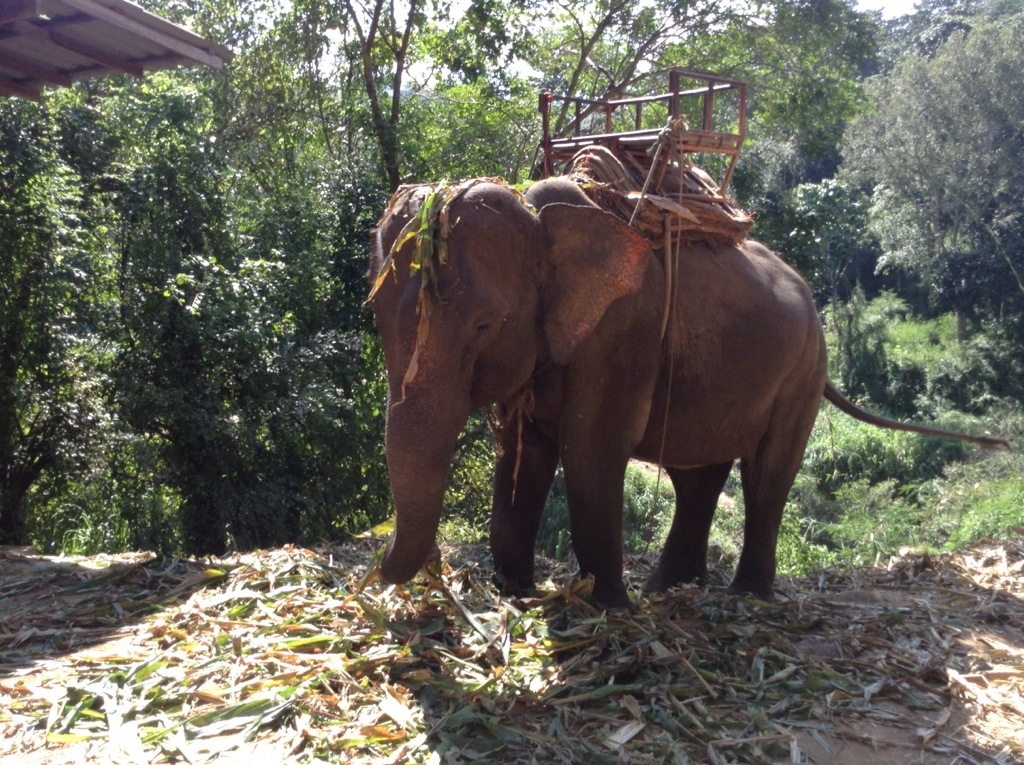
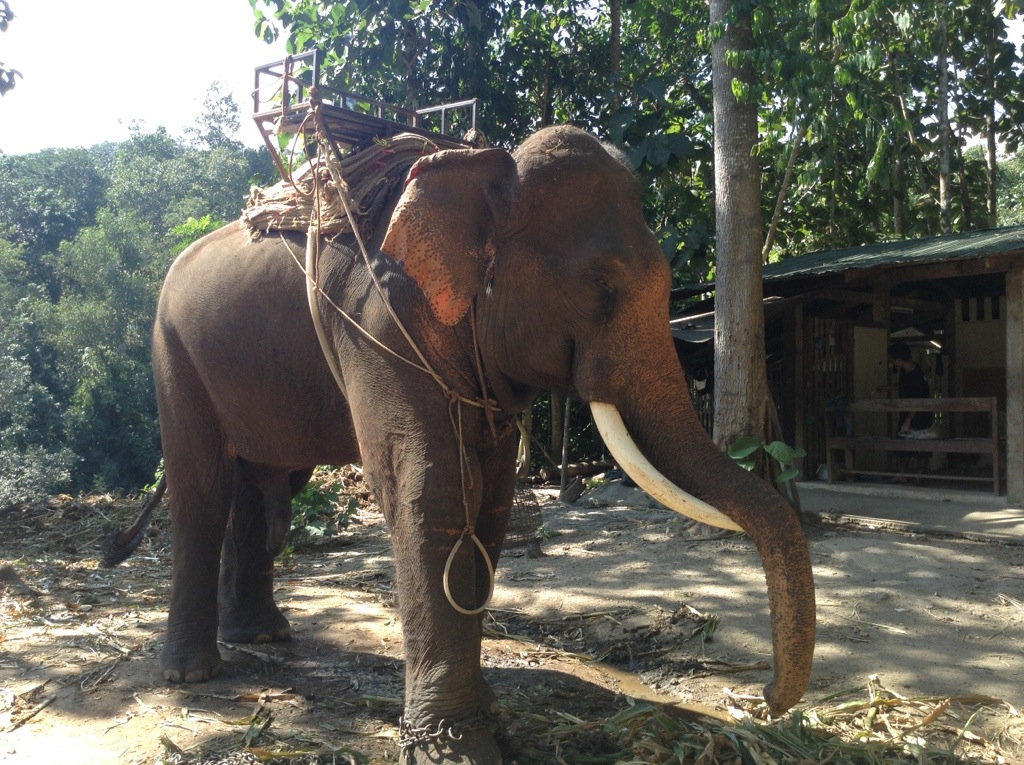
Daisy’s heart sank when we arrived and saw the elephants. While they looked healthy, with an unending supply of bananas and sugar cane to eat, this was clearly a tourism elephant camp. The lodge across the river, while running programs to teach gentle and humane mahut-ing, was not the owner of the elephants. They were each chained around one foot to keep them wandering off and in between eating they carried a stream of people around a half hour loop through the forest.
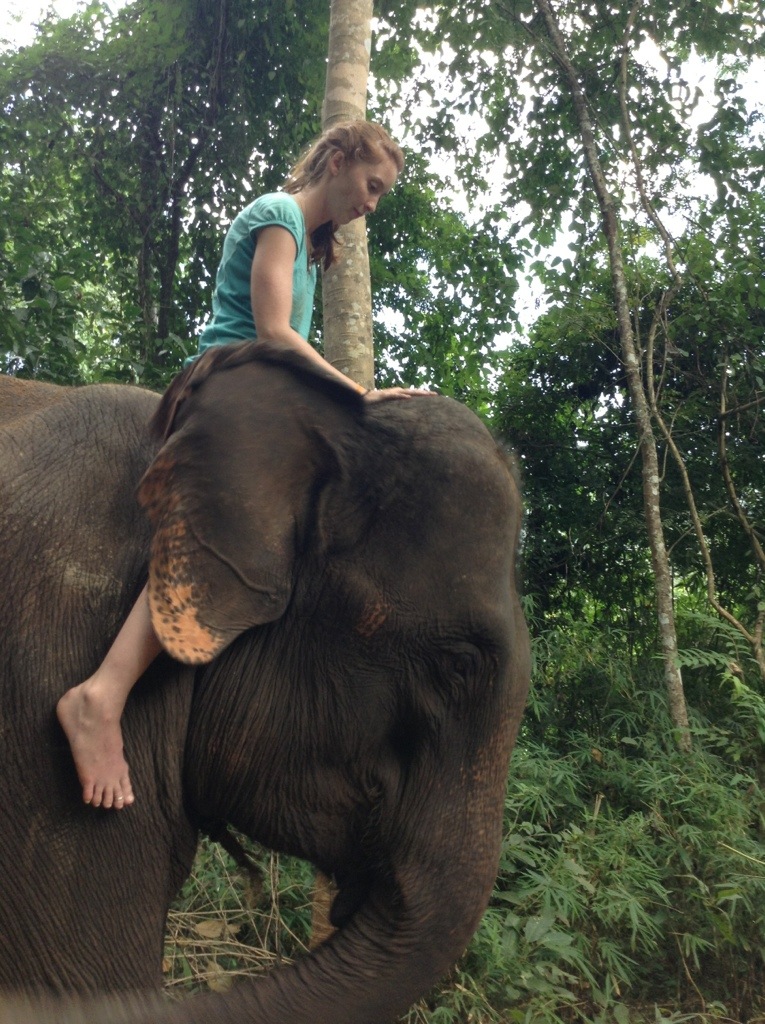
We weren’t sure what to think and I admit I did not think very hard. We had put faith in this place and had come to interact with the elephants and so we did. We sat and watched them eating for a long time. We got pushed around by the adorable baby. We touched the bull’s impressive tusks. We fed them. And when the time came we climbed up on their shoulders and rode them through the jungle. Each elephant has their own mahut. Both of the mahuts with us walked along on the ground next to their elephants. They did not have bull hooks and only used touching and voice commands. They wandered off the path a few times to forage without any punishment. And when we reached the river they were clearly so happy to sink in and let us wash them behind their ears.
The whole time my friend was conflicted. Over dinner she started googling how to tell if an elephant is happy and she was traumatized with all the horrible things she read. Her guilt and regret were huge.
I am absolutely an animal lover. I almost became a wildlife biologist. When I’m home I do not eat factory processed meat. I help earthworms and turtles cross the road. Any cruelty makes my heart hurt. But to me the use of animals is not such a clear line. I have seen enough to know that often in the developing world it comes down to using animals or using people. I can not imagine going up to a farmer in Honduras and saying “Sorry, you can’t use that mule. He has feelings. You can carry the concrete bags up the mountain yourself.” We have been using animals for thousands of years, and at this point the only options for transport are man, animal, or machine (unsustainable oil consumption). Yes, animals are sometimes abused, and I will never be okay with that. But I understand it as a complex question.
So the “elephant issue” became a week long exercise in critical thinking.
We talked to the owner of the lodge who is clearly having a love affair with the elephants. We learned that these elephants are free in the jungle at night except for two who have repeatedly gone off and destroyed entire fields and food stands. The two that carry chains around their necks are “runners,” and wrapping the chain around a tree is the only way to stop them when they bolt. They were all born into captivity or rescued from logging camps, not caught from the wild.
We talked to people who went to the highly regarded Elephant Nature Park. We learned that their elephants also have a mahut each, because the elephants are so dependent on humans that they need to be brought all of their food and told when to go to sleep.
We compared riding elephants with riding horses, compared that with catching wild eagles and training them to hunt with you. We talked about how we use dogs and cats for many things, and how they are now so far away from their original natures.
We agreed that yes, ideally the use of elephants would stop. We know that they are extremely intelligent, social, and emotional. But we also know that they require ridiculous amounts of space. It would be completely impossible to conserve enough land for the couple thousand of working elephants here; even more impossible to pay a person each to care for them and feed them. I remember someone in the WWF honestly telling me that they think we should let tigers go extinct. They don’t fit in the world we have created and we spend tons of money and resources trying to protect the few left. I still refuse to believe that we should let species succumb to the mess we’ve made, so maybe the only other option is to co-exist. But maybe co-existing with elephants is not feasible, except in situations such as this. Elephants can be extremely destructive. In this situation they are controlled from destroying people’s livelihood but allowed to live without (we hope) abuse. In fact, elephants are many people’s livelihood, and then “freeing the elephants” becomes a human economic issue as well. It did when elephant logging was outlawed a few decades ago. Maybe the elephant riding stops and we start admiring them from the ground.
But is that just my human guilt speaking? Is it selfish if me to want to keep animals on this planet even when they aren’t allowed to be the way they naturally are?
If the only realistic options for elephants in this world are extinction or tourist camps like the one we saw, which would you choose?